
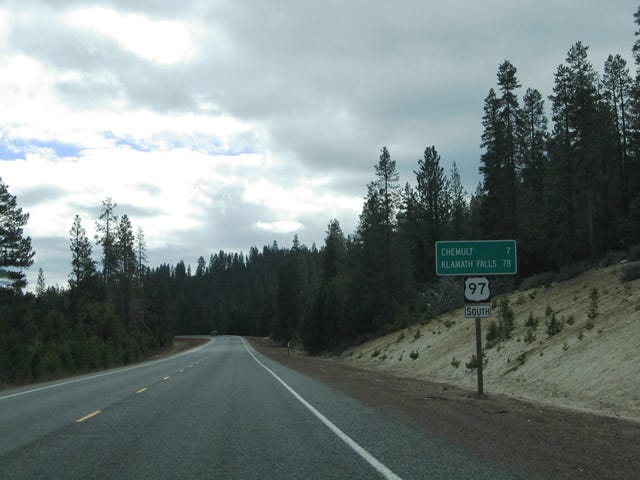
On August 20, 1986, the silent volcanic plateau of Chemult, Oregon, finally gave up a secret it had held for two years. Deep in the woods near Highway 97, at an elevation of 4,700 feet, investigators found the remains of Norberto Cruz Rodriguez. A 43-year-old from Los Angeles, he was found nearly 800 miles from the city streets he called home.
Rodriguez wasn’t a local drifter or a hiker who lost his way. His death was a calculated, violent relocation. Today, his case sits at the intersection of the investigative limits of the 1980s and the high-resolution forensic power of the 21st century—a puzzle defined by missing time, professionalized violence, and the way the system often silences those labeled as “others.”
The distance between Los Angeles and the high desert of Klamath County is the first great mystery. The choice of Chemult as a disposal site points to a high level of criminal planning. Highway 97 is a major arterial route through the Pacific Northwest, a quiet alternative to the heavily patrolled Interstate 5. In the 80s, this corridor was a path of least resistance for anyone looking to move between states unnoticed.
There is also a haunting void in the timeline. While Rodriguez was found in August 1986, his LAPD case file—number 846266—shows he was reported missing in 1984. That two-year gap is telling. It suggests his body wasn’t dumped in a panic; it was a deliberate move by someone with intimate knowledge of Oregon’s isolated topography.
The autopsy paints a picture of a two-stage assault: physical domination followed by a calculated end.
First, Rodriguez suffered several broken ribs—the result of heavy, blunt force meant to incapacitate him or perhaps force him to talk. Then came the execution. Rodriguez was shot three times in the face at close range. The choice of a small-caliber weapon, like a .22 or .25, is a specific signature. In ballistics, the kinetic energy formula Ek=21mv2 explains why: these rounds have enough energy to pierce the skull but often lack the momentum to exit. They ricochet inside the cranial vault, devastating the brain. Firing multiple shots into the face is often seen as “overkill”—a behavioral red flag suggesting the killer wanted to ensure the victim was unrecognizable or was sending a message.
The investigation eventually hit a wall that still frustrates cold case detectives: they developed suspects, but never secured indictments. It’s a classic “Suspect Paradox”—investigators were reasonably sure who did it, but they couldn’t bridge the gap between suspicion and the proof required by a court of law.
In 1986, “beyond a reasonable doubt” relied on physical evidence that was almost impossible to gather across an 800-mile divide. The jurisdictional split between Oregon and California further paralyzed the search for justice. OSP detectives were stuck relying on teletypes and manual records. Without digital databases, the threads connecting a missing man in LA to a body in Oregon were thin and easily lost.
Societal bias played a quiet role as well. There was a distinct “hierarchy of victimhood” in the mid-80s. When Gerald Flurie, a white resident, was found in a shallow grave in nearby Deschutes County just weeks later, the case received significant regional media attention. Rodriguez’s case, however, was relegated to the police logs. That media silence had real consequences; it kept his story out of the public consciousness, which meant potential witnesses never came forward. His death was dismissed as transient violence, a label that often stops investigators from putting in the work needed to break a code of silence.
But the modern era is offering new keys to this old lock. The Oregon State Police Cold Case Unit is now using tools that could finally vet the suspects identified decades ago.
Forensic Genetic Genealogy (FGG) can now build ancestral trees from biological material found on clothing or at the scene, even if the perpetrator isn’t in a criminal database. Meanwhile, the National Integrated Ballistic Information Network (NIBIN) allows detectives to digitally compare the three projectiles found with Rodriguez against every firearm seized across the country over the last forty years. If that weapon was used again, the link is now searchable.
Furthermore, forty years changes people. Allegiances fade. The fear or loyalty that kept people quiet in 1986 often gives way to a desire for a clean conscience as suspects age.
Norberto Cruz Rodriguez was more than just a case number. He was a man whose life and death were buried by the limitations of a bygone era. The evidence suggests that while investigators in 1986 likely knew who was responsible, they lacked the scientific bridge to reach a verdict.
Today, that bridge exists. Science has reached a point where the ability of the guilty to hide in the shadows is rapidly shrinking. It’s a reminder of our collective responsibility to look back. Will we finally listen to what the evidence has been saying for nearly forty years, or will we let this window of justice close forever?