
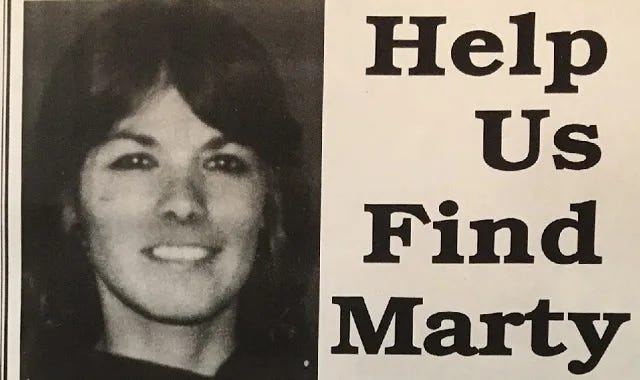
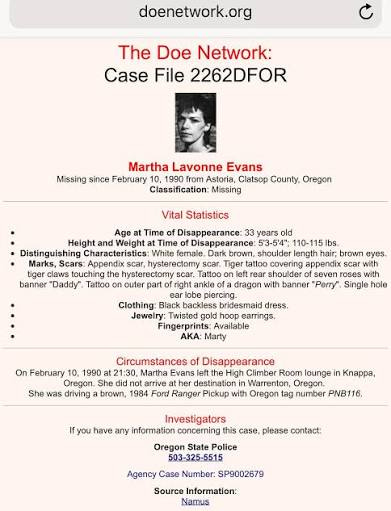
On the night of February 10, 1990, 32-year-old Martha Lavonne “Marty” Benthin Evans stepped out of a celebration and into a mystery that would haunt Oregon for over three decades. Fresh from her role as a bridesmaid, she disappeared alongside a borrowed 1984 brown Ford Ranger. Today, thirty-six years later, her case stands as one of Clatsop County’s most enduring cold cases—a tragedy defined not just by what we know, but by the catastrophic failures of the systems meant to protect her.
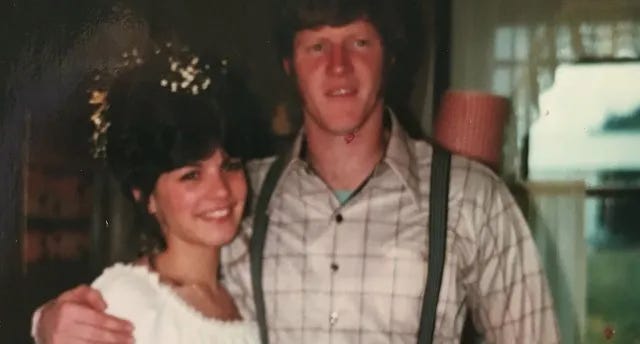
The verified facts of Marty’s final hours are hauntingly sparse. She was last seen wearing a custom-made black backless bridesmaid dress paired with a black leather jacket. In a detail that still chills investigators, she left a gathering in Knappa, Oregon, leaving behind her purse, her identification, and her money.
Later that evening, the timeline flickers at the D&D Market near Astoria. Witnesses saw Marty visibly upset, crying while using a payphone. Because the borrowed Ford Ranger was notoriously unreliable, her brother, Mike, arrived to give the truck a jump-start. He watched her drive away toward Astoria, where she was supposed to meet her sister at a restaurant.
She never arrived. Neither Marty nor the brown pickup truck have ever been seen again.
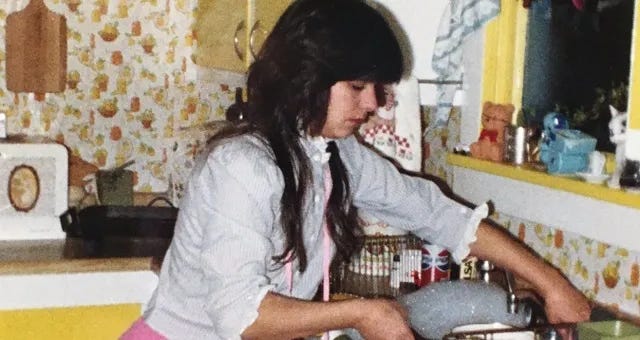
Perhaps the most staggering element of the Evans case is the institutional void that followed her disappearance. In 1990, law enforcement classified Marty as a “runaway adult.” Despite the abandoned purse and the late-night distress, police refused to file an official missing person report. That report wouldn’t be filed until 2005—an astonishing fifteen-year delay.
This gap was fatal to the investigation. Because there was no active case, there was no systematic canvassing of local bars, no collection of biological evidence, and no preservation of security footage. By the time the authorities began looking, the trail wasn’t just cold; it had been paved over by time.
Because the police refused to validate the disappearance for over a decade, initial media coverage was non-existent. As Marty’s sister poignantly noted, “No missing person report equals no investigation.” Without an official story, the local press had nothing to print.
When the media finally took interest years later—fueled by the rise of true crime podcasts, Reddit threads, and YouTube investigators like Adventures With Purpose—the reporting was a fractured mirror. Without a police-verified timeline, contradictions flourished. Some outlets reported Marty left the wedding for an urgent errand; others, like The Daily Astorian, claimed she stopped at her mother’s house for gas money and visited a local bar called “The Logger” before her truck stalled.
In the absence of facts, community rumors rushed in to fill the vacuum:
- The Deathbed Confession: A persistent story of a man admitting to burying Marty and her truck in the dense Wickiup Watershed.
- The Drug Ring: Speculation that she witnessed a drug bust that same night or was targeted by a local dealer.
- The Dead Investigator: A cinematic rumor that a private investigator solved the case, only to suffer a fatal heart attack the night he was to hand over his evidence.
While these stories make for gripping digital content, they highlight the difficulty of separating local lore from the grim reality of a missing woman. Essentially, the speculation was all a load of shit.
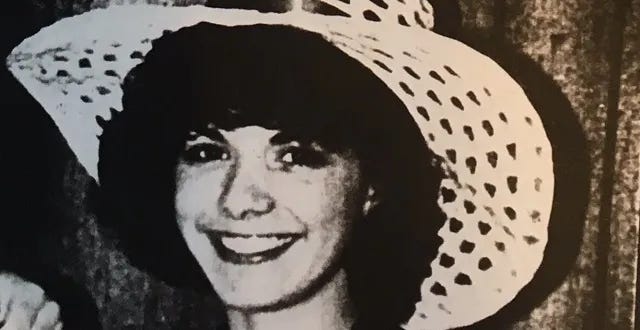
To understand why Marty’s case stayed silent for so long, one must look at the media landscape of the early 90s. This was an era of physical newspapers and local evening news. There was no internet to crowdsource a search, no social media to apply public pressure, and no digital footprints to track. Missing persons relied entirely on official police press releases. Since the Oregon State Police maintained that Marty had simply “voluntarily disappeared,” the media had no directive to cover her. Her story was effectively silenced before it could ever reach the public eye.

Despite modern efforts involving high-tech sonar searches of local waterways, Martha Evans remains a ghost of the Oregon coast. Her case serves as a somber reminder of the “permanent blackout” created when authorities dismiss a disappearance at the outset. For a grieving family left to sift through decades of rumors and contradictions, the search for the truth continues, even as the shadow of that 1990 night grows longer.
This concept represents a classic failure of accountability: the moment when either the media or the authorities “choose” the narrative they find most convenient. When the people tasked with protecting us prioritize ratings or professional laziness over their core responsibilities, the result is a total breakdown. It creates a mess that robs the public of critical thinking, leaves the family to suffer in silence, and forces future investigators to answer for the incompetence of their predecessors.
Whether the media decides to sensationalize a story for a ratings boost or stays silent because they don’t think a specific case “sells,” the result is the same. It comes down to a fundamental breach of ethics. By choosing the quickest path to profit or the easiest way out, they fail the public and abandon the pursuit of unbiased, integrity-driven reporting.
I am putting these words to paper because I know I’m not alone in my frustration: the department should be ashamed for so callously brushing this family aside. Shame on every single one of you, here today and in the ground. The accountability never leaves you.