
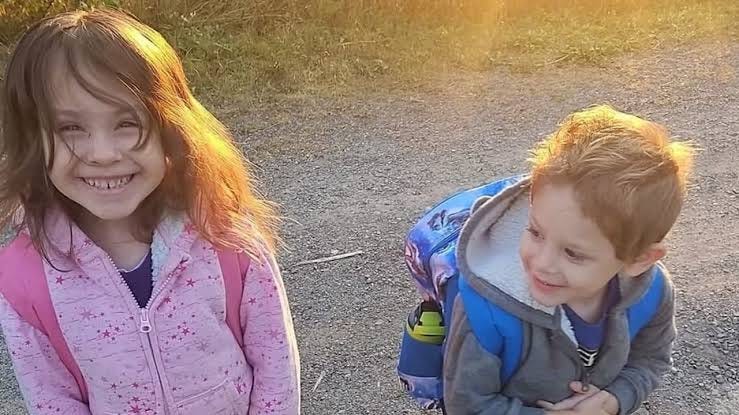
It has been nearly ten months since six-year-old Lilly Sullivan and four-year-old Jack Sullivan vanished from the rural community of Lansdowne Station, Nova Scotia.
What began on May 2, 2025, as a desperate, large-scale wilderness search has steadily morphed into one of the most complex and baffling missing persons cases in modern Canadian history. Today, the investigation is less about combing the dense, primary forest and more about untangling a deeply layered behavioral and criminal puzzle. As the community braces for a highly anticipated court appearance in early March 2026, newly unsealed documents and a sudden arrest have pushed this case into a critical new phase.
To understand the gravity of the investigation, you have to look at the setting. The siblings lived on a heavily wooded, high-density rural property on Gairloch Road. They shared the home with their biological mother, Malehya Brooks-Murray, their 34-year-old stepfather, Daniel Robert Martell, and a 16-month-old baby sister, Meadow. Martell’s mother, Janie MacKenzie, lived just steps away in a separate trailer on the exact same property. The children are also members of the Sipekne’katik First Nation, a detail that later became a flashpoint for Indigenous leaders demanding a reformed national alerting system after an Amber Alert for the children was initially denied.

The integrity of the investigation currently hinges on a timeline riddled with contradictions and a massive blind spot overnight. The children had been kept home from school starting Wednesday, April 30, due to a professional development day, and remained home through the end of the week because Lilly reportedly had a cough. The last time anyone outside the family definitively saw the children alive was the afternoon of Thursday, May 1. Between 1:53 and 2:25 p.m., surveillance cameras captured Brooks-Murray, Martell, the infant, and both Lilly and Jack shopping at a Dollarama in New Glasgow.
That evening, Brooks-Murray told police she put the children to bed between 9:00 and 10:00 p.m. Lilly was dressed entirely in pink, wearing a sweater, pajamas, and socks, with her backpack resting beside her bed. Jack was in a t-shirt, black sweatpants, and a diaper. According to Martell, he stayed up late that night, eventually went to bed, and did not wake until daylight.
But the hours between midnight and 4:00 a.m. have become a glaring dark window for investigators. Unsealed court documents recently revealed that two neighbors, Brad Wong and Justin Smith, reported hearing a loud vehicle moving to and from the family’s property during the early morning hours of May 2. Wong, whose property sits at an elevated position, told police he saw vehicle lights cutting across the treetops and heard the vehicle leave the address three to six separate times. Smith corroborated the activity, noting the vehicle turned around near the railroad tracks. When confronted with these reports, Martell vehemently denied them, calling the claims complete nonsense. He insisted the only vehicle they had access to belonged to Brooks-Murray, wasn’t loud, and never moved out of the yard that night.
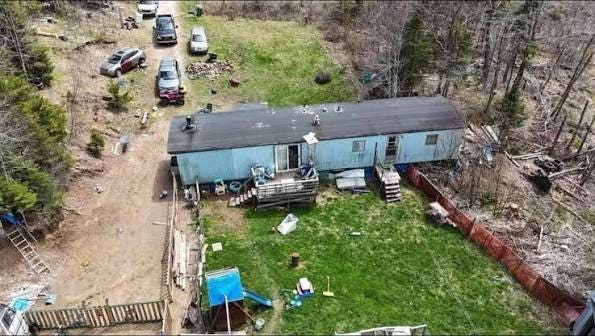
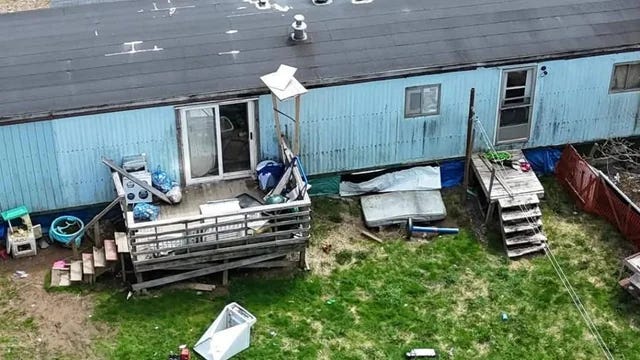
The official narrative of the following morning only deepens the mystery. At 6:15 a.m., Brooks-Murray used a school app to mark the children absent. Between 8:00 and 9:40 a.m., both parents claimed they were in their bedroom with the infant. They told investigators Lilly came in and out of the room, and they could hear Jack playing in the kitchen. Martell specifically noted that a wrench he had placed on top of the front door remained completely undisturbed, leading him to assume the children must have silently slipped out through the back sliding door. Meanwhile, in the trailer next door, step-grandmother Janie MacKenzie reported waking up between 8:50 and 9:00 a.m. to the sound of a dog barking. She claimed she heard Lilly and Jack laughing and playing on the backyard swings before she drifted back to sleep. Just over an hour later, at 10:01 a.m., Brooks-Murray dialed 911 to report them missing.
The immediate response was monumental. Over 160 volunteer searchers, RCMP tracking dogs, helicopters, and drones equipped with thermal imaging descended on Lansdowne Station, scouring 8.5 square kilometers of unforgiving terrain and the banks of the nearby Middle River. Heavy rain and fog severely handicapped the tracking dogs, and by May 7, authorities officially scaled back the ground search, noting that the probability of survival was very low.

In a case completely starved for biological evidence, the few physical clues that were found only created a forensic paradox. On the day the children disappeared, relatives found a piece of Lilly’s pink blanket snagged in a tree on Lansdowne Station Road, roughly a kilometer from the house. Inexplicably, tracking dogs brought to that exact spot couldn’t detect a human scent. Two days later, police seized a matching piece of the exact same blanket from a trash bag at the end of the family’s driveway. Brooks-Murray told investigators she had thrown it away a week earlier, while Martell admitted he had ripped the blanket himself to use as a makeshift draft blocker for a door. Subsequent searches, including a massive 40-kilometer sweep by specialized cadaver dogs from Western Canada in September, turned up nothing. A November search by the charity Please Bring Me Home located a t-shirt and tricycle near the river, but the RCMP quickly deemed them irrelevant to the siblings.
With physical evidence lacking, investigators turned to the RCMP Truth Verification Unit. Seven polygraph examinations were conducted. Cody Sullivan, the children’s biological father who hadn’t seen them in three years due to a custody dispute, was heavily investigated, interviewed for two hours, and cleared after passing his polygraph on June 12. Interestingly, both Martell and Brooks-Murray took polygraphs on May 12, and their responses to specific questions were deemed truthful. This initially led one investigator to write that the disappearance wasn’t believed to be criminal in nature. However, Janie MacKenzie’s polygraph in June was ruled inconclusive because her physiological responses were unsuitable for analysis. This left a massive, unresolved evidentiary gap, as she remains the only adult who claimed to hear the children outside that morning.

The perception of a peaceful rural home was entirely shattered in January 2026, when media requests forced the unsealing of heavily redacted court documents used to obtain search warrants. The files painted a picture of intense domestic volatility. During a May 9 interview, Brooks-Murray alleged that Martell was physically abusive. She described instances where he would try to block her, hold her down, and once pushed her. Crucially, she stated that he would physically seize her phone when she tried to call her mother, describing the act as physical and hurtful. She also admitted to using a Wi-Fi-based messaging app called TextPlus to secretly contact her family on the morning the children vanished, before quickly deleting the software.
Martell pushed back hard against these unsealed allegations, telling the media that he never abused Malehya and that a false narrative had been set to paint him as an evil person, calling the situation absolutely insane. But the documents show that the volatility exploded on the very day the children vanished. Maternal relatives immediately accused Martell of involvement, leading Martell’s mother to kick them off the property. By May 3, the maternal grandmother, Cyndy Murray, learned of Martell’s alleged history with methamphetamine and cocaine, sparking a heated yard argument that police now view as a pivotal moment in the family dynamic.
The legal trajectory of the case shifted dramatically on Monday, January 26, 2026, when the RCMP arrested Daniel Martell. Days later, they confirmed he was charged with assault, sexual assault, and forcible confinement. The RCMP was careful to explicitly state that these charges involve an adult female victim and stem from an incident on December 1, 2024, at the Gairloch Road property, exactly five months before Lilly and Jack vanished. Officially, authorities maintain these charges are unrelated to the missing children. Yet, the behavioral overlap is questionable, as Brooks-Murray’s unsealed claims of being blocked, held down, and having her phone taken align closely with the legal definition of forcible confinement. Martell was released on conditions and is scheduled to appear in Pictou provincial court on March 2. None of the charges have been proven in court.
As February draws to a close, the RCMP continues to treat the disappearance as a highly active and intensive investigation. The operational metrics are staggering. Investigators have assessed over 1,111 public tips, managed more than 1,400 active tasks, conducted 86 formal interviews, and reviewed upwards of 8,100 functioning video files from dashcams, trail cams, and commercial security systems. A $150,000 standing reward from the Province of Nova Scotia remains on the table for information of investigative value. While the region has seen a recent uptick in police activity with unrelated province wide warrant arrests of local men for assault charges, the focus of the Major Crime Unit remains firmly fixed on the Sullivan household.
RCMP Staff Sgt. Rob McCamon recently reiterated the team’s commitment to establishing exactly what happened to Lilly and Jack, noting they are pursuing every lead and applying every resource to move the file forward. As the March 2 court date for Daniel Martell approaches, the community of Lansdowne Station watches closely, waiting to see if the mounting legal pressure will finally break the silence surrounding the fate of two young children.