
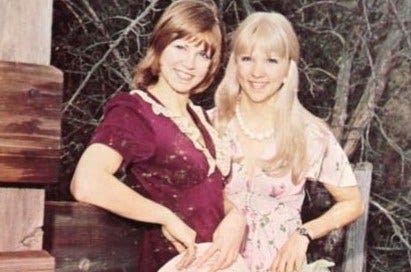
In 1974, twenty-two-year-old Debbie Roe and her teenage sister Vicky were right on the edge of making it. They weren’t just singing at local Vancouver clubs for fun; they had just flown to Nashville to record an album backed by the exact same studio musicians who played for Elvis Presley and Bob Dylan.
They came home to Langley, British Columbia, as rising stars, even performing for the local elementary school. Their dad, a backhoe operator named Emil, couldn’t have been prouder.
But by February 1975, that dream was violently snuffed out, leaving behind a shattered family and a cold case that still haunts the Lower Mainland nearly fifty years after the fact.
When I look at the timeline of Debbie’s final night, the sheer vulnerability of her situation stands out. To support her music, Debbie worked as a cocktail waitress at the OK Corral in New Westminster.
Back in the ‘70s, working in the nightclub scene meant navigating long, pitch-black commutes through isolated, rural terrain. On Saturday, February 22, she clocked out around 2:00 a.m. and got into her blue Chevy Nova. We know she drove along the King George and Fraser Highways toward Langley, making a quick, routine stop at a Denny’s for gas and food. That Denny’s stop is chilling in hindsight. It was one of the few places open that late, making it the perfect, brightly lit spot for a calculating predator to watch her, see she was alone, and decide to follow her into the dark.
The next day, her Nova was found abandoned on a desolate stretch of the Fraser Highway known as Fry’s Corner. At first glance, you might think the car broke down and she tried to hitchhike. But her roommate was adamant that the Nova was in great shape. More importantly, the car was found locked. In 1975, a young woman driving alone at night doesn’t just abandon a perfectly good, locked vehicle in a sudden panic. That specific behavioral clue tells us she was either tricked by a ruse, approached by someone she recognized, or pulled over by someone presenting themselves as an authority figure.
The only physical trace left behind was a single, size-nine footprint in the dirt near the driver’s side door.
The investigation shifted from a missing person search to a homicide when a family out for a walk found Debbie’s body in a rural part of Langley, about seven kilometers from her car. The details from the autopsy are brutal. She had been severely beaten, sexually assaulted, and strangled. But the actual cause of death showed a terrifying level of cold calculation: she was left face-down to drown in just six inches of water. The coroner called it an “enraged frustrated attack.” This wasn’t just a crime of opportunity; it was a passive execution by someone who felt a psychological hostility toward her.
Over the decades, the Langley RCMP vetted numerous suspects, but no one was ever charged. Her family always maintained that Debbie was far too cautious to get into a car with a total stranger. Because of that, a few prominent theories have lingered.
Was it an older male acquaintance who was infatuated with her, where a rejection triggered that “enraged” assault? Or was it something far more sinister? There is a deeply disturbing theory involving two police officers who had previously stopped Debbie on her way home just to ask her out. If a cop flashes his lights on a dark highway, you pull over, get out, and lock your doors—it perfectly explains the state of her abandoned car.
You also can’t ignore the terrifying pattern of violence happening in the area right at that time, often referred to as the “Nightclub Murders.” Just two months before Debbie was killed, a 22-year-old named Barbara LaRocque was found murdered near Langley. She worked at a club with the exact same ownership as the OK Corral. A month after Debbie’s death, Gail Rogers, a dancer at the Penthouse Nightclub, was found murdered off the Sea to Sky Highway. It looks suspiciously like a highly mobile serial predator was specifically hunting women in the local entertainment sector.
The hardest part of this case to stomach is the catastrophic failure regarding the evidence. In the mid-1990s, when DNA testing was revolutionizing cold cases, the Roe family asked authorities to test the biological evidence collected from the 1975 crime scene. They were bluntly told the evidence was lost. Vanished from the decentralized, poorly tracked evidence lockers of the era. That institutional mistake essentially severed the most direct path to identifying the killer.
The psychological toll on Debbie’s family has been immense, compounded by police who kept them entirely in the dark about suspects.
Even local music legends, like Terry Jacks of the Poppy Family, were remembered sitting quietly in the Roe family kitchen, mourning the vibrant life that was stolen.
The RCMP did officially reopen the case in 2003, hinting at “new information”—maybe a deathbed confession or a new witness—but the public is still waiting for answers. As one Vancouver forensic expert famously said about unsolved cases from that dark, rural era: “we don’t catch the smart ones.”
Whoever did this used the dark environment to their advantage and knew exactly how to minimize trace evidence. But someone out there knows who left that size-nine footprint on the Fraser Highway, and Debbie’s family is still waiting for the final piece of the puzzle.